Appearance
Practical Limits
For project limits, find the area, read what Miaou does, choose the safe workaround, then jump to the workflow guide with the practical steps.
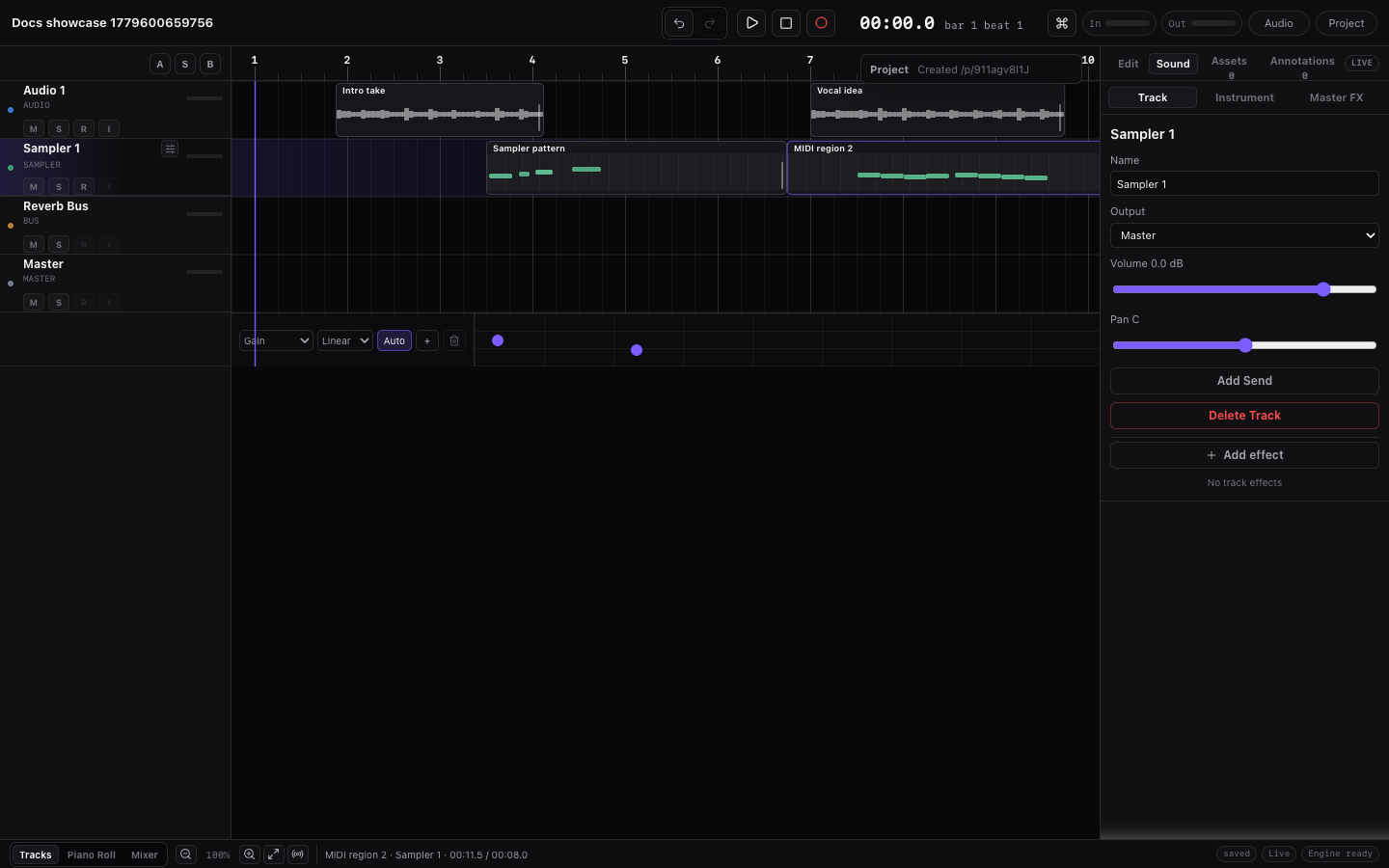

Find the Safe Workaround
Start by matching the situation:
| Situation | What it means | Best next page |
|---|---|---|
| A supported feature does not behave correctly | Treat it as a troubleshooting problem first. | Troubleshooting |
| The feature works but has quality boundaries | Read what to expect here, then use the linked workflow guide. | The matching workflow from Quick Limit Map |
| The workflow is intentionally simple | Use the documented workflow and linked controls. | Feature Index for feature lookup and linked workflow pages |
| The problem is browser, permission, or project | Check setup and project state before changing musical material. | Browser and Device Setup, Save, Share, and Export |
If a workaround might change a lot of music, create a version first. A limit should not force destructive guessing.
Quick Limit Map
| If you are blocked by... | Read this section | Then use this workflow guide |
|---|---|---|
| Browser speed, graphics, MIDI permissions | Browser and Device | Browser and Device Setup, Troubleshooting |
| Large projects, first-play stutter, slow panels | Browser and Device, Effects | Large Projects and Performance, Browser and Device Setup |
| Project access, sharing, passwords, versions | Project Access | Save, Share, and Export |
| Recording passes, takes, comping | Recording | Recording, Takes and Comping |
| Missing sounds, kit pieces, custom samples | Instruments | Instruments |
| Chord analysis, Follow Chord Track, generation | Chords and Scales | Analyze and Generate |
| BPM, Source BPM, imported tempo maps, stretching | Tempo | Tempo and Follow Project Tempo, Audio Regions |
| Audio key/chord/transient/groove analysis | Audio Analysis | Audio Regions, Tempo and Follow Project Tempo |
| Selection, undo, loop playback, editing limits | Editing | Editing Basics, Timeline Editing |
| Effects, sends, master controls, audio quality | Effects and Audio Processing | Mix and Automate, Automation Lanes, Effect Reference |
| ZIP export, stems, MIDI export, missing media | Export | Save, Share, and Export, Import and Export |
Before You Work Around a Limit
- Save the project or make a version before a risky edit.
- Check the workflow guide linked from the table above.
- If the problem is unexpected, use the Troubleshooting symptom map.
- For large projects, reduce realtime load first: collapse or switch away from heavy analyzers, mute unused tracks, and export when you need a reliable offline render.
- Treat audio analysis, chord analysis, and tempo detection as editable suggestions, not final truth.
Browser and Device
- Miaou is designed for current desktop Chrome or Chromium.
- The layout is dense and expects a desktop-size viewport.
- Timeline drawing depends on modern Chrome graphics features. If regions do not draw correctly, update Chrome and check Troubleshooting.
- Realtime playback requires the browser setup provided by https://miaou.app/. Copied app files, embedded previews, or older browsers can prevent realtime audio from starting.
- Web MIDI depends on browser support and permission.
- Large projects, many simultaneous instruments, dense MIDI, many Track Effects, tempo-following audio, and analyzer-heavy sessions can hit browser CPU or memory limits before a native DAW would.
- See Browser and Device Setup for the setup checklist.
- See Large Projects and Performance for practical project habits before reducing musical content.
Project Access
- There are no user accounts.
- Projects are opened by project link and password.
- There is no password change or recovery flow.
- Unlocked browser sessions last about 12 hours.
- See Save, Share, and Export for the safe project-link workflow.
Recording
- Single input recording is supported.
- Miaou records one browser audio input at a time.
- Input monitoring is for audio tracks.
- Audio loop recording can create separate takes for each completed pass through the transport loop brace.
- Simple comping is split-region based: split the loop-recorded audio region and choose the active Comp take per slice. Compact take lanes support rename, mute, remove, and active-take selection. Miaou does not include dedicated stacked waveform lanes, swipe comping, crossfade lanes, or MIDI loop-take lanes.
- Export renders the active take on each comp slice and includes referenced take media in the project ZIP.
- See Recording and Takes and Comping for the recording and comping workflow.
Instruments
Use Instrument for musical choices and Instrument Sources and Licenses only when source, credit, or publishing details matter.
| If you need... | What Miaou does | Practical choice |
|---|---|---|
| A fast starting instrument | Starter shows a compact palette of kits, piano/keys, bass, guitar, pad, and lead instruments. | Start there before searching the full catalog. |
| Strings, brass, woodwinds, mallets, or FX | All and family filters expose compact safe-source catalog instruments for those families. | Search globally in Instrument, then preview before loading. |
| Drums or percussion | Drum parts are kit-first. Individual kit pieces appear as named drum lanes, not separate top-level sounds. | Load a full kit, then program Kick, Snare, Hats, Cowbell, Ride, Crash, percussion, and FX lanes in the drum editor. |
| Transition FX | FX such as risers, reverse cymbals, hits, drops, and tape-stop colors are playable MIDI instruments. | Put them on a MIDI track and place notes where the one-shot should trigger. Use audio regions when you need waveform fades. |
| A custom one-sample instrument | A selected audio region or imported sample can become the source for a MIDI track. | Use it for playable chops, textures, and quick sampling. |
| A detailed sampled-instrument editor | Miaou does not include full multisample mapping, velocity-layer editing, round-robin editing, or key-zone authoring. | Use the built-in catalog, a custom one-sample instrument, or export MIDI/audio to a dedicated sampler workflow. |
| Separate mixing for each drum lane | Built arrangements and imported General MIDI drums stay as full kit-backed MIDI tracks. | Use separate MIDI tracks when you need independent processing, or render/export audio when you need separate files. |
Most melodic instruments use compact multisample ranges rather than large studio-library depth. Built-in drum and percussion kits use exact-key zones for common General MIDI drum notes plus named percussion lanes. Choir Pad and Ooh Voice are voice-style synth pads, not sampled choir or solo-vocal libraries.
Imported melodic General MIDI instruments are mapped to the nearest built-in instrument when Miaou can make a clear match. Check the created tracks in Instrument after import, especially when the source file depends on a very specific external instrument library.
See Instruments for catalog behavior, kits, previews, and imported samples.
Chords and Scales
- Chord blocks are project harmony data. They do not produce full arrangement audio by themselves, but they drive chord-tone fitting, Follow Chord Track playback/export, MIDI generation, and arrangement sketches.
- Chord blocks use beat positions. The top bar exposes one project BPM control; imported MIDI tempo maps are preserved and can drive imported clip timing, but Miaou does not include a manual tempo-map editor.
- Chord extensions are limited to none, 7, maj7, and 9.
- Chord-symbol typing supports the same chord model: major/minor/diminished/augmented/sus2/sus4, 7/maj7/9, and slash bass. Extended symbols such as 13ths are outside Miaou's chord symbol parser.
- Slash bass is available per chord and affects generated bass patterns.
- Chord MIDI generation offers Close, Open, and Spread voicings plus Main, Variation, and Fill generation passes. Held chord stacks use compact voice-leading during generation. Miaou does not include custom per-chord voicing lanes.
- Follow Chord Track is a per-MIDI-region playback/export transform. It fits melodic MIDI notes to chord tones non-destructively and intentionally skips drum-kit regions.
- MIDI-to-chord analysis needs enough harmonic evidence to name a chord. It can use major/minor two-note fragments when the defining third is present, but fifth-only/power-chord dyads can stay empty instead of being guessed as major, minor, or sus.
- Snap-to-scale affects newly drawn MIDI notes and the explicit Fit notes action. It does not rewrite existing notes automatically.
- Regenerating chord-generated MIDI replaces the generated region notes from the source chords. Selected-range and marker-section sources prefer current Chord Track blocks when they cover the whole saved source range; if that range has no current chords, regeneration can use the saved chord snapshot. If current chords cover only part of the saved source range, regeneration stays disabled so Miaou does not silently drop bars. Use undo if you need to restore manual edits.
- See Analyze and Generate, Chords and Scales, and MIDI Editor for the full workflow.
Tempo
- The top-bar BPM control edits the project tempo at beat
0. Miaou does not include a manual tempo-map editor. - Imported MIDI tempo events are preserved for MIDI export. Depending on the MIDI import tempo policy, they can also drive imported clip timing or update the project tempo map.
- Audio Follow project tempo uses the region's Source BPM and saved timing choices. It is per-region, not per-track.
- Audio tempo following is non-destructive, but not artifact-free. Extreme tempo increases/decreases, exposed vocals, cymbals, dense full songs, and material with heavy reverb can reveal stretching artifacts.
- Source BPM detection is transient-based. It can return a half-time or double-time interpretation, so the Selection inspector exposes detected, half, and double Source BPM choices.
- Tempo markers can anchor loose timing inside one audio region. Quantize can build marker lists from detected transients and the current grid, but detection is not perfect and dense marker lists can make sustained material sound uneven; correct Source BPM first, then add only the markers you need.
- Beats usually protects transient timing, Tones usually protects sustain, Default is the safest first pass, and Tape changes pitch by design.
See Tempo and Follow Project Tempo for the complete mental model and common mistakes.
Audio Analysis
Audio analysis is a sketch helper. Miaou writes useful results back into editable project objects: region timing choices, tempo markers, MIDI groove changes, project key, and Chord Track blocks.
- Transient slicing and tempo detection are local waveform-onset helpers. Tempo detection needs a regular transient pattern.
- Source BPM detection can return half-time or double-time interpretations. The Selection inspector exposes detected, half, and double Source BPM choices so you can correct it before enabling Follow project tempo.
- Audio groove extraction uses detected transient timing from one selected audio source slice. It can push MIDI notes toward that feel, but it does not extract velocity, articulation, or a complete drummer-style performance model.
- Audio key detection is a local tonal-center estimate for major/minor material.
- Apply BPM + key + chord can apply confident local hints from a selected audio slice as project tempo/key and one editable Chord Track block.
- Create audio chords scans up to 16 bar-sized segments from the selected region start. It writes only confident segment estimates as editable Chord Track blocks and merges adjacent matching estimates into longer blocks.
- Re-running audio chord analysis replaces the analyzed audio span. Low-confidence bars stay empty instead of preserving stale earlier guesses.
- Audio chord estimation can suggest common triads, diminished/augmented chords, sus chords, dominant sus chords, sevenths, major sevenths, diminished/augmented sevenths, ninths, and clear slash-bass inversions with confidence and candidates.
- Fifth-only or power-chord material may stay empty instead of being guessed as major, minor, or sus, because Miaou requires enough active chord tones plus the tone that defines the chord quality.
- Audio analysis is not full-song transcription, reliable automatic downbeat detection, or guaranteed chords for every bar.
Best first pass:
- Trim or select the clearest 4-16 bar region.
- Correct Source BPM and downbeat before asking for chords.
- Run the analysis.
- Treat low-confidence or empty bars as a prompt to add/correct Chord Track blocks manually.
- Use undo if the result is not useful.
See Audio Regions, Tempo and Follow Project Tempo, and Analyze and Generate for the editable workflows.
Editing
- Undo/redo is global for arrangement, MIDI, chord, marker, track setup, routing, instrument, send, Track Effect, and master automation edits.
- Continuous live controls such as track-head fader drags, pan drags, send-amount drags, instrument parameter drags, and Track Effect parameter drags save immediately but do not create undo-stack entries.
- Automation lanes focus on Track Effect and Master Effects parameters. Track-head faders, pans, mute/solo, and sends are saved static mix controls, not lane-automated controls.
- The visible timeline always starts with at least five minutes of runway and grows while scrolling. The visual timeline cap is two hours.
- The transport loop range is saved project transport state and syncs with collaborators. It repeats realtime playback only; export does not automatically render only the loop range unless an explicit export-range workflow is selected.
- Bus tracks are routing targets, not recording or region-hosting tracks.
- Audio Follow project tempo is non-destructive and uses saved source audio plus region timing choices, including optional tempo markers. Extreme tempo changes can still produce audible artifacts, so choose Default, Beats, Tones, or Tape by source material and verify by ear.
- In-note MIDI velocity handles are optimized for quick editing. The Piano Roll does not include a separate full-height velocity lane.
- See Audio Regions for imported and recorded audio-region editing. See Editing Basics for selection, clipboard, duplicate, nudge, trim, split, loop, and undo behavior.
Effects and Audio Processing Quality
- Realtime playback and export are designed to use the same signal-flow decisions, but browser CPU load can still affect realtime monitoring smoothness.
- Pitch, Shifter, Resonator, Vocoder, Bitcrusher, Pedal, and Amp / Cab are creative processors. They can sound intentionally colored, aliased, metallic, or phasey at strong settings.
- Pitch shifting is useful for parallel layers and special effects, but it is not a full transparent vocal/instrument pitch-correction suite.
- Vocoder uses an internal carrier model. It is useful for robotic and synthetic textures, not a full external-carrier modular vocoder workflow.
- Reverb and Room cover practical algorithmic space and early-room/reflection color. Miaou does not include imported impulse responses or advanced convolution editing.
- Limiter and Clipper are practical loudness and peak-control tools. They are not a substitute for dedicated mastering metering in every release workflow.
- Analyzer and LUFS-style readings are useful mixing guides, but final release targets should still be checked with the destination platform or a dedicated meter when needed.
- See Mix and Automate, Automation Lanes, Effects and Automation, and the Effect Reference for signal flow and effect parameters.
Collaboration
- Collaboration uses shared project link/password access.
- Temporary locks reduce conflicts but are not a permission system.
- Explicit versions remain the recovery mechanism.
- See Collaboration and Save, Share, and Export for safe sharing and recovery habits.
Export
- Export creates a downloadable ZIP.
- Export requires an unlocked project.
- Export supports projects up to 2 hours. Longer projects are rejected with a clear error instead of being silently truncated.
- Referenced project audio files must be restored in the unlocked project before export.
- MIDI file export downloads MIDI clips plus preserved MIDI events and project timing data. It does not create audio.
- Imported MIDI tempo maps are preserved for MIDI file export and are used for imported clip playback/render timing.
- Audio regions with Follow project tempo enabled are time-stretched during realtime preview and export from the original referenced source audio.
- Master output mute, volume, and balance affect realtime playback and the exported
project-mix.wavafter Master Effects. Per-track stems stay source-track based and do not include final Master output controls. - Per-track stems include source-track audio and Track Effects, but they do not include final Master Effects or final Master track-head mute/volume/balance.
- Per-track stems are omitted when the ZIP would exceed the stem size guard; the full mix and project/source files are still exported.
- See Save, Share, and Export and Import and Export for the practical export workflow.
Storage
- Imported audio upload limit is 100 MB per file.
- Project audio file storage is handled by Miaou; there is no separate project media maintenance workflow.
- If saved audio is missing after reload, unlock the project first, then use Troubleshooting.
Related Pages
- Troubleshooting maps symptoms to focused fixes.
- Large Projects and Performance explains practical browser and project habits.
- Feature Index lists the available feature set.